Master Class
Classes, Objects and OOP
Objects, constructors, inheritance, and polymorphism, connected instead of memorised.
- First 5 seats each week
- $150 CAD
- Seats 6 to 30
- $197 CAD
- When
- Every Saturday, 12:00 PM Eastern
- Length
- 3 hours
- Class size
- 4 to 30 students
- To hold a seat
- $50 deposit
Every Saturday at 12:00 PM Eastern, online and live.
Master Classes run Every Saturday at 12:00 PM Eastern.
A $50 deposit holds the seat. The balance is charged automatically to the same card 24 hours before class, which is also the moment the seat list locks.
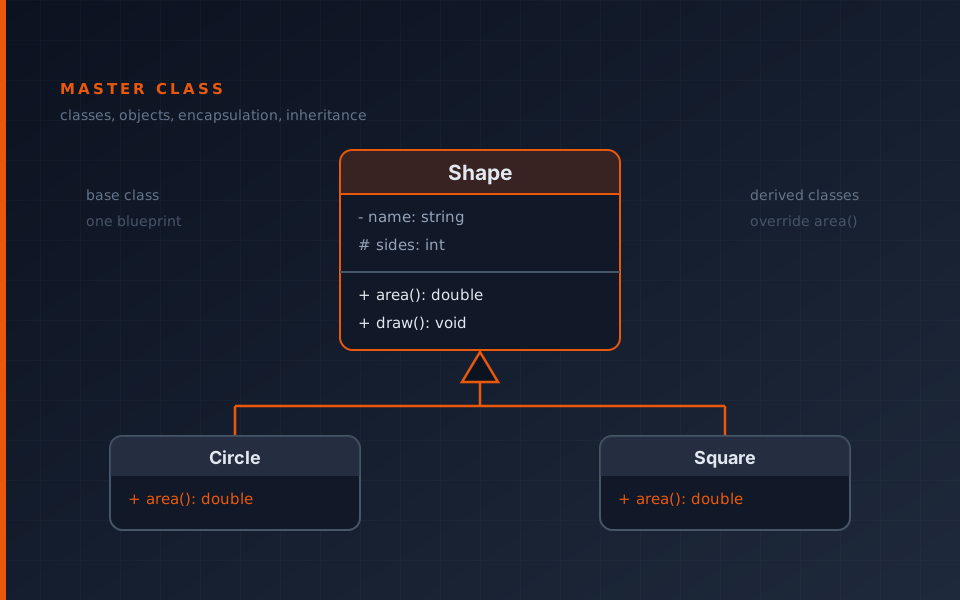
The mastery check
You leave able to do these four things, cold, with AI closed:
- Turn a paragraph of requirements into classes, fields, and methods, and defend the split.
- Write a small class hierarchy from an empty file, with a working override.
- Say which method runs for each object in an unfamiliar polymorphic loop.
- Point at polymorphism in your own code and explain what it bought you.
You cannot? The class is free and you can sit it again every Saturday until it clicks.
Every Saturday
Next class: Every Saturday at 12:00 PM Eastern
200+
students taught
This format is not an experiment
Over 200 students have been through these Master Classes, and every one of them has passed the topic they came for. That is the whole reason the guarantee below can be written the way it is.
The mastery check
The standard is written down before you pay
Every Master Class ends with a mastery check: a short set of problems on the topic, done by you, with AI closed and notes shut. The exact things you have to be able to do are listed on this page before you book. Nothing gets graded on vibes, and nothing gets decided after the fact.
You pass OOP and Classes when you can, cold, with AI closed:
- Turn a paragraph of requirements into classes, fields, and methods, and defend the split.
- Write a small class hierarchy from an empty file, with a working override.
- Say which method runs for each object in an unfamiliar polymorphic loop.
- Point at polymorphism in your own code and explain what it bought you.
Layer 3: Master it or it is free
If you show up, do the work, and still cannot do those four things by the end, you get a full refund. You keep the slides, the recording, the worksheet, and the solutions anyway.
And you can come back
If you sit a Master Class and do not pass the mastery check, your seat in every future run of that same class is free, permanently. Not one retake, all of them. The class runs every Saturday, so the next one is never more than seven days away.
You leave able to do it, or you do not pay for it
This is the only thing the class sells, so it is the only thing I will guarantee. Three layers, and you are covered by all three.
Layer 1
The 30 minute walkout
If, half an hour in, this is not what you thought you were buying, say so and leave. Full refund, same day, no explanation required and no awkward conversation.
Layer 2
The overtime promise
Three hours are scheduled. If the room is still shaky at hour three, we keep going, up to five hours, at no extra charge. I am not ending a class with students who still cannot answer the questions.
Layer 3
Master it or it is free
If you show up, do the work, and still cannot pass the mastery check by the end, you get a full refund. You keep the slides, the recording, the worksheet, and the solutions anyway, and you can sit any future run of the class free, as many times as you want, until it clicks.
Layer 3 asks one thing in return: that you actually tried. That means you attended the full class and handed in your attempt at the problem set, right or wrong. A blank page is not a failed attempt, it is a missing one. Refunds are issued within 3 business days.
Come back free, as many times as you want
If you sit a Master Class and do not pass the mastery check, your seat in every future run of that same class is free, permanently. Not one retake, all of them. The class runs every Saturday, so the next one is never more than seven days away.
Is this you?
You are in the right class if any of this lands
- You can define polymorphism and cannot point at it in your own code.
- You do not know what belongs in a class and what belongs in main.
- Constructors, this, and super all feel like syntax you memorised.
- Inheritance versus composition is a coin flip every time.
- Your UML diagram and your code have nothing to do with each other.
None of that means you are bad at this. It means one topic never got drawn for you properly, and everything built on top of it has been guesswork since.
After 3 hours
What you will be able to do
- Decide what should be a class, a field, and a method, and defend it.
- Write constructors, getters, setters, and toString or operator overloads correctly.
- Use inheritance where it belongs and composition where it belongs.
- Explain and demonstrate polymorphism with your own working example.
- Read a UML diagram and turn it into code, and the reverse.
- Structure a multi class assignment without the whole thing collapsing.
The plan
The three hours
3 hours scheduled, up to 5 if the room still needs it, at no extra cost.
Hour 1
What a class really is
- Objects in memory, fields versus locals, and what this refers to
- Constructors, overloading, and initialisation order
- Encapsulation as a decision, not a rule you follow
- Live coding: one class built properly from nothing
Hour 2
Many classes talking to each other
- Building a small system as a class, three or four types
- Inheritance, overriding, and abstract or virtual methods
- Polymorphism demonstrated with a loop over mixed objects
- UML to code, live, using your own assignment shape
Hour 3
Your problem set
- Design and write a small class hierarchy from a description
- Fix a design where inheritance was the wrong answer
- Exam style: what method actually runs here, and why
- You work, I circle, nobody gets handed an answer
Hour three is a supervised problem set, not a queue for my attention. You work, I am live the whole hour, and I unstick whoever stalls.
The problem set
Four questions off the actual worksheet
- Which method executes for each object in this loop?
- Turn this UML diagram into working classes.
- This subclass breaks its parent contract. Explain how and fix it.
- Design the classes for a library system from a paragraph of requirements.
The full worksheet and the worked solutions are sent to you after class, so you can redo the whole thing cold a week later and find out what actually stuck.
What you get
Everything included with your seat
A real lecture, not a chat
One hour of structured teaching with slides and live coding, built for this one topic. You watch it get built, drawn, and broken on purpose.
Guided problems, together
One hour solving real problems as a class. I drive, then you call the shots, and everyone predicts what the code does before we run it.
Your own problem set
One hour where you solve problems yourself, with me live the whole time to unstick anyone who stalls. This is the hour that decides whether you actually learned it.
The slides, forever
The full slide deck sent to you after class. Yours to keep, reread the night before the exam, and annotate.
The recording, forever
The full session recorded and sent to you. No expiry, no platform to stay subscribed to. Rewatch the part you lost the thread on.
The worksheet and the answers
Every practice question from the class plus worked solutions, so you can redo the whole thing cold a week later.
What it would cost if you bought it separately
3 hours of live teaching on one topic
Lecture, live coding, guided problems, and a supervised problem set, all aimed at a single topic instead of a whole syllabus.
$120
Bonus: Up to 2 extra hours if the room needs them
Free. We do not stop at three hours if three hours was not enough.
$80
Bonus: The full slide deck, yours forever
The exact deck taught from, sent after class. Reread it the night before your exam.
$40
Bonus: The complete recording, yours forever
No expiry and no subscription to keep paying. Rewatch the ten minutes you lost the thread on.
$60
Bonus: The worksheet plus full worked solutions
Every problem from the class with the reasoning written out, so you can redo the whole thing cold a week later.
$50
Bonus: 7 days of follow up on your attempts
Send me your work on the worksheet within a week of class and I reply with written feedback. This is where the learning actually sets.
$60
Bonus: Free re-attendance, forever
Did not pass the mastery check? Sit the same class again next Saturday, and every Saturday after that, at no charge until it clicks.
$120
Total value
$530
What you pay
First 5 seats each week. per student, one flat fee, nothing else to buy.
$150
then $197 for seats 6 to 30
Master Classes run Every Saturday at 12:00 PM Eastern.
Booking
How a seat actually works
Every Saturday at 12:00 PM Eastern, online and live. 4 to 30 students, $150 for the first 5 seats and $197 after that, resetting every week.
How booking and paying works
You request a seat here, and nothing is charged on this page. I reply personally within 24 hours to confirm your spot for that Saturday and send payment details. Pay by card or e-transfer, whichever you prefer.
- No card details on this site. Requesting a seat costs you nothing.
- I reply within 24 hours to confirm your spot and send payment details.
- Pay by card or e-transfer, whichever suits you.
- Your seat is confirmed once payment is in, and the list locks 24 hours before class.
What if fewer than 4 people sign up that week?
Then you choose, and either way you are not out of pocket. Option one: we run it anyway as a short session, 2 hours instead of 3, same price, and we still go to 5 hours if you need them. With that few people it is close to private tutoring. Option two: you roll to the next Saturday at no cost and keep your early bird price. Nobody gets told "sorry, cancelled" and left with nothing.
Run it short
2 focused hours instead of 3, same price, still extendable to 5 hours if you need them. With a handful of students this is closer to private tutoring than a class.
Roll to next Saturday
Move to the following week at no cost and keep whatever price you locked in.
Master Classes run Every Saturday at 12:00 PM Eastern.
What you need before you come
You can write functions, loops, and arrays. Tell me Java or C++ when you sign up and the whole class is taught in that language.
Not sure you are ready? Say so when you book and I will tell you honestly, even when the honest answer is a different class.
Where this topic shows up
Your course code is probably not on that list, and that is fine. The topic is the same everywhere. Only the assignment wrapper changes.
What the alternative actually costs
Retaking one course costs most students somewhere between $600 and $1,500 in tuition, plus a semester of their life and a mark that stays on the transcript. Every student who has to retake a programming course failed on a small number of topics, usually the ones on this page. The class starts at $150.
Why there is a clock on this
- The first 5 seats each week are $150. Seats after that are $197, in the same class, for the same 3 hours.
- Hard cap of 30 students. There is no seat 31, no matter who asks.
- The list locks 24 hours before class, because that is when the worksheets get printed and the room is set.
- A class runs once 4 students are in it. Below that you choose: a shorter session at the same price, or roll to next Saturday free.
- One topic per class. I do not merge two topics to fill a room.
If you want more after
It comes off your first invoice if you want more
If you book 1:1 tutoring or mentorship within 14 days of your Master Class, everything you paid for the class comes off the first invoice. Worst case, the class was free and you found out what you needed next.
OOP and Classes Master Class FAQ
I have never touched OOP and Classes before. Is this class too advanced for me?
You can write functions, loops, and arrays. Tell me Java or C++ when you sign up and the whole class is taught in that language. The class starts from the picture, not from the syntax, so arriving knowing nothing about the topic itself is normal and expected.
When does this class run?
Every Saturday, at 12:00 PM Eastern, online and live. The exact date of the next one, and the countdown to the seat list locking, are both at the top of this page. 3 hours are scheduled and the room can run to 5 at no extra cost.
Which language will the problems be in?
This class runs in Java, C++. You tell me which one when you book your seat, and the live coding and the worksheet are written in the language your course actually uses.
Will this match my course, or is it generic OOP and Classes content?
It is built for the way this topic gets tested in courses like Seneca OOP244, York EECS 1022 and 2030, ITEC 1620, UofT CSC207, AP Computer Science A. Send your course code and your outline when you book and the problem set gets aimed at your version of it.
What exactly do I have to be able to do by the end?
Four things, and they are listed on this page before you pay: Turn a paragraph of requirements into classes, fields, and methods, and defend the split. Write a small class hierarchy from an empty file, with a working override. Say which method runs for each object in an unfamiliar polymorphic loop. Point at polymorphism in your own code and explain what it bought you. That is the mastery check, and it is done with AI closed and notes shut.
What happens if I still cannot do it at the end?
If you show up, do the work, and still cannot pass the mastery check by the end, you get a full refund. You keep the slides, the recording, the worksheet, and the solutions anyway, and you can sit any future run of the class free, as many times as you want, until it clicks. If you sit a Master Class and do not pass the mastery check, your seat in every future run of that same class is free, permanently. Not one retake, all of them. The class runs every Saturday, so the next one is never more than seven days away. Layer 3 asks one thing in return: that you actually tried. That means you attended the full class and handed in your attempt at the problem set, right or wrong. A blank page is not a failed attempt, it is a missing one. Refunds are issued within 3 business days.
Why is a seat $150 in one place and $197 in another?
Both are real, and both buy the same class. The first 5 seats in every Saturday class are $150. Seats 6 through 30 in that same class are $197. It resets every week, so how early you book is the only thing that decides which one you pay. At either tier it is per student, one flat fee, nothing else to buy.
How does paying actually work?
You request a seat here, and nothing is charged on this page. I reply personally within 24 hours to confirm your spot for that Saturday and send payment details. Pay by card or e-transfer, whichever you prefer. Your seat is confirmed once payment is in, and the list locks 24 hours before class.
What if fewer than 4 people sign up that week?
Then you choose, and either way you are not out of pocket. Option one: we run it anyway as a short session, 2 hours instead of 3, same price, and we still go to 5 hours if you need them. With that few people it is close to private tutoring. Option two: you roll to the next Saturday at no cost and keep your early bird price. Nobody gets told "sorry, cancelled" and left with nothing. Run it short: 2 focused hours instead of 3, same price, still extendable to 5 hours if you need them. With a handful of students this is closer to private tutoring than a class. Roll to next Saturday: Move to the following week at no cost and keep whatever price you locked in.
How many people will be in the room?
4 to 30 students. It runs once 4 students are booked and it is capped hard at 30. Hours one and two are taught to the room. Hour three is a supervised problem set: you work, I am live the whole hour, and I unstick anyone who stalls.
What if 3 hours is not enough for this topic?
Then we keep going. 3 hours scheduled, up to 5 if the room still needs it, at no extra cost. I am not ending a class with students who still cannot answer the questions, and hours 4 and 5 are never billed.
Do I get the slides and the recording?
Yes, both, and they are yours forever. The full deck, the complete recording with no expiry and no subscription to keep paying, the worksheet, and the worked solutions. You keep every piece of it even in the case where you take the refund.
How is this different from just booking 1:1 tutoring?
A 1:1 session is hourly and shaped around whatever you bring that day, which is the right call when an assignment is due or your problems are spread across a whole course. A Master Class is one topic, 3 hours on a fixed Saturday, a written standard you have to meet, and a room of 4 to 30 students so you also hear the questions you did not think to ask.
Other Master Classes
Same format every Saturday: 3 hours, 4 to 30 students, $150 for the first 5 seats and $197 after that, and the same guarantee. Only the topic changes.
C Pointers
Stop guessing where the star goes
C++C++ Pointers
References, pointers, and who owns the memory
Any languageArrays
The topic everyone assumes you already got
Any languageRecursion
The moment recursion stops feeling like a trick
C, C++, or JavaLinked Lists
Build the whole data structure, not just use it
C and C++Strings
Why your string is one byte too short
Classes, Objects and OOP, in one Saturday afternoon
3 hours, 4 to 30 students, $150 for the first 5 seats and $197 after that, and you pass the mastery check on OOP and Classes or the class is free and you keep everything anyway.
Every Saturday at 12:00 PM Eastern, online and live.
Master it or it is free. A $50 deposit holds the seat and the balance is charged 24 hours before class.